Publication de l’équipe Mollicutes de l’UMR 1332 BFP. Nathalie Arricau-Bouvery, Marie-Pierre Dubrana, Sybille Duret, Xavier Foissac, Sylvie Malembic-Maher.
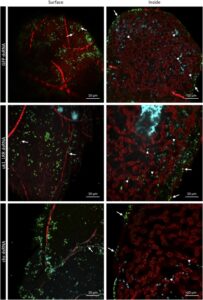
Fig. 5. Observation by laser scanning microscopy with an Airyscan detector of salivary gland cells of FD phytoplasma infected E. variegatus that have ingested GFP, uk1_LRR or chc dsRNA. Cell nuclei were stained with DAPI (cyan), actin filaments with Alexa 568-phalloidin (red) and phytoplasmas with anti-VmpA antibodies and Alexa 488-secondary antibodies (green). “Surface” indicates the view of the infected salivary gland cell surface; arrows indicate protruding filaments. “Inside” indicates the view of the inside of the same infected salivary gland cell; arrows indicate FD phytoplasmas at the surface of salivary gland cells and arrowheads FD phytoplasmas inside these cells. Scale bar 10 µm.
Résumé (anglais) :
The “flavescence dorée” (FD) phytoplasma is transmitted from grapevine to grapevine by the leafhopper Scaphoideus titanus. In experimental conditions, this phytoplasma is also transmitted by the leafhopper Euscelidius variegatus to broad bean in which it multiplies and induces symptoms. To be transmitted to plants, phytoplasmas must invade different cell types of their insect vectors. The process of cellular endocytosis involves both bacterial and eucaryotic factors such as adhesins and receptors. In the present study, it is shown that entry of fluorescent beads coated with the adhesin VmpA of the FD phytoplasma into cultured E. variegatus cells depends on the putative receptor Uk1_LRR and clathrin of the insect. In vivo experiments have shown that silencing of uk1_LRR gene increased the colonization of E. variegatus by the FD phytoplasmas without effect on the plant transmission. On the contrary, silencing of clathrin gene significantly reduced the colonization of E. variegatus and the transmission to broad bean.