
Nouvelle publication : Deciphering letermovir's mode of action and resistance mutation effects

Cette publication est issue de la collaboration entre l’UMR 1092 – Anti-Infectieux : supports moléculaires des résistances et innovations thérapeutiques (RESINFIT) de Limoges et l’Institut Toulousain des Maladies Infectieuses et Inflammatoires (INFINITY) de Toulouse. Publiée dans la revue Antiviral Research, elle porte sur l’interaction des protéines du complexe terminase du CMVH en présence de létermovir et de mutations de résistance.
C. Gourin a, T. Flores b, C. Lefèvre a, S. Alain a c, G. Ligat b 1, S. Hantz a c 1

  • Résumé (anglais): 
Human cytomegalovirus is an opportunistic pathogen responsible for severe infections in immunocompromised patients, the leading cause of congenital infections worldwide, and potentially implicated in carcinogenesis. The HCMV terminase complex (pUL56-pUL89-pUL51) has emerged as a key target for antiviral drug development. Letermovir, an antiviral agent targeting this complex, inhibits viral DNA packaging, but resistance-associated mutations have already been identified within subunits. Moreover, the precise mechanism of action of letermovir remains incompletely understood.
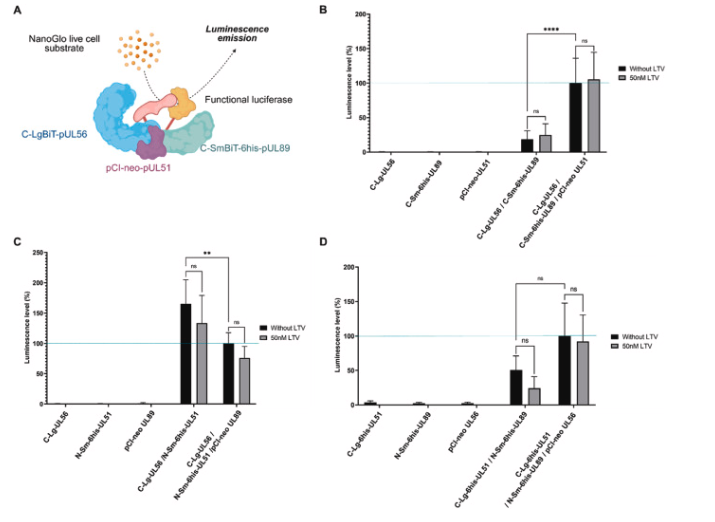
We investigated interactions among terminase subunits in presence or absence of letermovir. Wild-type and mutant forms of these proteins (including resistance mutations V236M, L241P, L257I, C325Y, R369M in pUL56 and A95V in pUL51) were cloned into NanoBiT® PPI and pCI-neo vectors. Letermovir was added after transfection in HEK293T cells, and protein-protein interactions were assessed.
Our results show letermovir does not disrupt interactions between wild-type terminase subunits. Resistance-associated mutations modulate the strength of these interactions, with certain mutations (such as pUL56 V236M and L257I) significantly enhancing or reducing binding. Notably, double mutants exhibited synergistic effects. Structural analysis using the AlphaFold3 platform revealed differences between the mutation site of pUL56 and its HSV-1 counterpart pUL28. A hypothetical 3D analysis based on the cryo-EM structure of the HSV-1 terminase complex showed that resistance mutations were oriented outside the complex.
These findings suggest letermovir does not act by directly inhibiting interactions among HCMV terminase subunits. Analysis of resistance-associated mutations provides insight into the molecular basis of HCMV resistance to letermovir and may inform development of novel antiviral strategies targeting the terminase complex.